


In a Kingdom of Birds
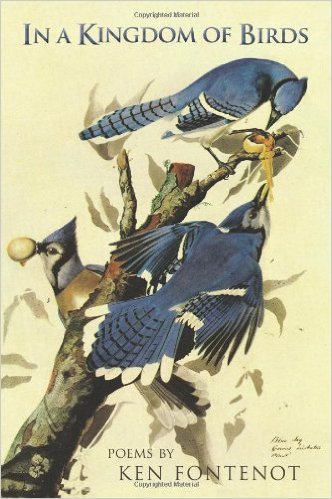
 by Ken Fontenot,
Pinyon Publishing, 2012,
73 pages, paper, $15.00,
ISBN: 978-1-936671-07-6
Buy the Book
Can ordinary lives be written simply? Too much mundane detail, and readers drown in trips to Walmart for cat litter, or must grapple with prose poised like safety pins on used clothing, as if literature is a Goodwill bin of the past. Then again, in Gabriel Garcia Marquez’s great novel One Hundred Years of Solitude, among the almost mind-numbing repetitions — similar sounding names, the descriptions of the family’s house being freshly painted or going to seed — there resounds a single, clear bell of loneliness. That kind of purity recalls Ken Fontenot’s poetry.
There’s a contrast in Fontenot’s work between enduring daily routines and a longing to transcend boundaries. He listens for “the high-pitched sound the universe made when it began.” He startles readers with these lines from “Let’s Go Out,” a poem with a clearly stated challenge:
Listen again. You missed it the first time.
Your thoughts were elsewhere. We say,
enough of love, and we mean it. We say,
enough of money, and we mean it.
I wouldn’t give one solitary cent for a new car.
You neither? Let’s go out. The lightning bugs
are as bright as your eyes.
The night is as young as the world.
Fontenot’s narrators in these poems speak from solitude. Their observations are given to readers in a bright, colloquial tone that often contains undercurrents of irony or despair, creating poetic tensions. Family life is also described, with memories of an aunt who says, “The dust has gone to Heaven,” along with Evangeline Parish, in Louisiana, and all the hard-working men with “their belts six or seven notches / on the good side of hunger.” A poem called “From a Son Who Knows Only Books” is a meditation on men who do honest, skilled work with their hands, and on the narrator’s father:
A man is happy with his gun, his boat.
A man is happy with his lawn, his dog.
Just think. I’ll not grow up to be my father.
A childhood full of light and shadows permeates the book, as well as the keenly observed movements of birds. Their cruelty is noted, such as their raiding of nests, but birds also serve as quirky, unpredictable metaphors that imply transcendence. Idealism is never entirely destroyed, even in adulthood. All of us, says Fontenot, hold the kingdom of birds within us, as in these lines from “Our Lips Are Gates”:
Grief: that child in cold weather without
a coat. It sings dirges. It writes elegies.
We with half our noses in shadow, half in light.
We with our bodies soaped and scrubbed.
The dark houses. Conversations in other rooms.
A fireplace. Of two doves
both will forage. Neither will wait.
Perhaps solitude begins to be valued in childhood as well, clarifying perceptions that often conflict. This is something readers can identify with, just as we do in Marquez’s novel. And Fontenot’s moths — they could be the cousins of Macondo’s butterflies, as in these opening lines from “The Words for Containment”:
In my dream, moths are pursuing me
the same way they always have to touch us
in real life. Daylight brings the dream to an end.
Memories of the poet’s childhood, savored as an adult, are turned over like beautiful oak leaves pressed between pages. In “The World Without Me,” as throughout In a Kingdom of Birds, Fontenot’s voice transcends sure boundaries:
I am close to my bed. I am close to my book.
I am close to my chair. And my silence lights the room.
— Sharon Olinka
Calendars of Fire
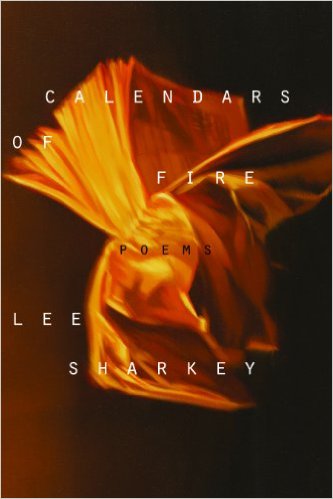
 by Lee Sharkey,
Tupelo Press, 2013,
60 pages, paper, $16.95,
ISBN: 978-1-936797-26-4
Buy the Book
“Why do we war on each other? This is an unanswerable question we should never stop asking,” writes Lee Sharkey in the reader’s companion to her latest book of poems, Calendars of Fire. Weaving together images from multiple wars, mythology, and personal accounts of grief, this collection of poems addresses the writer’s outrage and disbelief at a world of humans who enact violence upon one another, while also grappling with the inescapable truth we all face: mortality.
The poems often take the form of elegy, prayer, or vision. The theme of transience, introduced in the volume’s first poem, “In the wind,” creates an ominous feeling at the outset:
If you walk the same path everyday through the woods
clearing the way in your coming and going
you know when branches have fallen. Each branch downed
has a trace of the wind of descent vibrating through it.
Immediately Sharkey establishes an eerie sense of fate in this forest of “coming and going,” a barren container for the short experience of life itself. This is a timeless space where “you can read the night, the wind, the lack of it / what has happened back to happening,” a place through which every human and their ancestors have passed.
Desolate images of war proliferate throughout the second section of the book, with many poems formed in sequences of one- and two-line stanzas whose emotional and thematic strength resembles that of a ghazal. In “Hunger recounts it,” she presents the raw desperation caused by war in a scene where personal belongings and furniture are burned for temporary warmth: “Burned the books, first the history, last the poetry, page by crumpled page /No no, give that to me, a neighbor insisted,
trading Akhmatova for 2x4s from graveside crosses.” This haunting parataxis creates an unsettling and believable depiction of starvation during wartime.
Juxtaposed against this despair comes the series “Tiresias at last,” where the Greek god appears: a transgender, blind prophet who sees what others can’t. Strikingly more accessible in style and language, with shorter lines and a sensual tone, the Tiresias series offers respite from the hardship that’s come before. In a tighter, lyric narrative, Sharkey begins with a poem about his transformation from male to female, and continues with “Tiresias tells it”:
Desire is the snake that courses the body
The mouth is one door of its house, the vagina another
When you lie down you lie with the snake
When you rise up you rise with the snake
To insert a shape-shifting, sexualized being at this point in the book seems, at first, an odd choice. However, as Sharkey explains in the reader’s companion to the volume (which is accessible on her website), “All poets are at least in part Tiresias, senses attuned, listening from the sidelines; coveting vision, powerless to make that vision come to pass or prevent its coming.”
Indeed, Sharkey introduces a new strength with the sensuality and prophetic perspective of Tiresias, who, unlike humans, can see beyond the grip of war. Whereas the powerless subjects that appear in preceding poems evoke helplessness, Tiresias accepts human weakness without becoming the slave of it, as in “Seer in vigil”: “Tiresias stands in winter wind / doing nothing but stand in winter wind.” In submitting to the truth of human violence, s/he can rise beyond, redeemed by a broader knowing, as in “With birds on his shoulders”:
Violation rises like a planet
its own sound something quiet
like sliding bodies into water
Altogether, Calendars of Fire offers an evocative redefinition of what we might conceive as “war poetry.” Sharkey’s careful interweaving of language fragments and white space — to connect the personal and global — is most effective when a simple narrative emerges, and is not quite as successful in longer poems, like “Possession,” in which too many worlds and memories are merged to be easily grasped.
Her lyric becomes most clear and beautiful in section III, which presents the aftermath of war, the ruin of sacred places, charred and broken musical instruments, psychic demoralization, grace, and the rebuilding of lives. Amidst the rubble, there is “Listening”:
sleep with me now under the clouds
with your lucid eye open
What is it that I love when I
form the letter with an arc and a down-
stroke
The curve of your head,
my hand rounded to stroke it,
habitat, sphere of a new planet.
Indeed, with her keen vision, Sharkey honors the brutal suffering of the human world while still managing to seed hope for a new, more whole one.
— Kristen Stake
The Boss
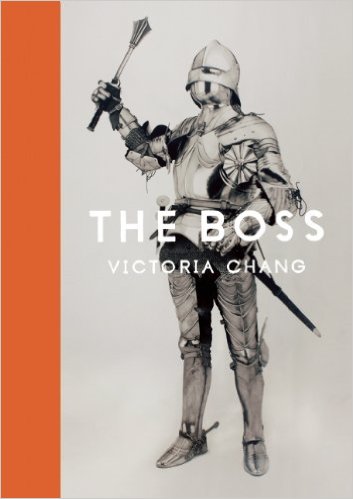
 by Victoria Chang.
McSweeney’s Poetry Series, 2013,
64 pages, paper, $16,
ISBN: 978-1-938073-58-8.
Buy the Book
“Her boss is somewhere where is her boss” Victoria Chang asks, flouting grammar, in her new book, The Boss. This past summer, I found one Boss in Pavlov’s Music, in the small Ohio town of Cambridge where I grew up. In the back of Pavlov’s, there’s a selection of used vinyl, which is where I found The Boss — in a dusty copy of his Nebraska that I had a feeling had been sitting in Pavlov’s since the day I’d bought my first guitar almost 20 years ago. As Chang knows, one can find the boss many places — at work, at home, in an Edward Hopper painting, in one’s self, or in Pavlov’s Music in Cambridge, Ohio. Was Bruce Springsteen who Chang meant as her ubiquitous boss? Probably not. However, the spirit feels right. The boss is everywhere.
“The boss is not poetic writing about the boss is not poetic,” Chang says in her poem “The Boss Is Not Poetic,” and that’s for sure. To write about the boss we all have, yet want to be, is to expose our power-hungry, power-deficient, masochistic selves. Definitely not comforting, and The Boss doesn’t leave a reader with a warm, fuzzy, I’ve-been-poured-over-the-landscape-by-poetry feeling. It’s more like the constant fear of checking your email at work one too many times and now the boss is on to you, and you are screwed because the boss don’t play games. Haven’t we all been there? Maybe, but most of us don’t want to think about it so much.
Chang is careful about how she doles out The Boss. Almost every poem is exactly a page; they all meander along the left and right margins and none of the poems have a stitch of punctuation, unless you count capital letters as punctuation, and even those are pretty slim: “can they do that / can she do that yes she can in this land she can.” The result is a rhythmic, blurry and hypnotic syntax that keeps a reader going forward and backward to catch the phrasing. One could find this irritating, but for the most part, I found it pleasing. It wasn’t hard to do, and in fact, because of this syntax, I found myself chanting in my head my own riffs about the boss: the boss is going to the bathroom to bathe in his room the boss is still the boss in the bathroom. . . . I recommend any potential reader to try this. It’s very fun and you’ll be bossing yourself in no time.
So, who is the boss? Who indeed. One boss becomes many. I’m a boss, you a boss, boss, boss me, okay, boss? The poet is a boss with her kids, but is bossed by her boss and, most poignantly, the poet’s father, once a Big Boss in the Business World, suffers a stroke and “when I / ask him the name of his old boss / he says his own name.”
This is a sadly delusional, stroke-impaired moment, but isn’t it true that we all would like to think we’re our own boss? You’re not the boss of me, I’m my own boss! (Insert here: some Ayn Rand/Libertarian/laissez-faire capitalism bullshit.) Well, that’s nice to think, but Chang knows better. You have to serve somebody, and for the most part in this book, the boss is a no-fly zone, the one who sits in the back of the office and points the employees toward the edge of the roof and says: jump, or you’re fired.
And yet, “We are still in awe of the boss and / the law and all the dollars.” The boss is still, and always will be, the boss, whether you find him in Pavlov’s Music (The Boss forever!), or if she haunts you as Victoria Chang’s book did me, bossing me around for days before I resigned myself to the fact that “[t]oday is the boss the boss is today.” I have a review to finish; the boss wants it, and the sooner I accept that, the better. She the boss.
— Jefferson Navicky
The Messenger
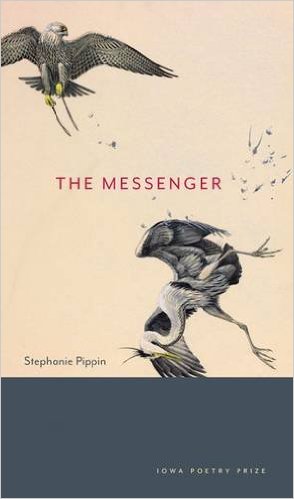
 by Stephanie Pippin.
University of Iowa Press, 2013,
70 pages, paper, $18,
ISBN: 978 -1609381646.
Buy the Book
Birds of prey hold a place on the arm of poet Stephanie Pippin’s narrator and especially in her consciousness in her book, The Messenger. In this clarion collection, which was awarded the 2012 Iowa Poetry Prize, Pippin meditates on the liminal boundaries and relationships between the human and the wild.
The narrator’s connection to falcons, vultures, and ravens, as she helps to hatch, heals, tethers, and releases them, is a commingling of awe and need. She is consumed in awaiting their birth, in “Hatch”: “The hours from pip / to hatch, days / to trace the breaks, to see / the shell breached, are agony.” She feels dwarfed by the vastness and vitality of the wild, musing in “Red Pines” that “the egg // is its own law and more real than I, more / alive — a galaxy her wings obey / in everything they do.” She vibrates with awareness of the power dynamics between the winged creature and the human who holds her; in “Summer,” that creature is a messenger of both the wild world and Pippin’s own mortality:
As if to break my wrist,
or will,
she foots the glove —
makes me know
my bones.
Complex powers of life and death play out in “Propagation,” amid
the narrator’s efforts at stewardship, to keep a species alive: “We,
too, are in servitude / to vultures. They hiss / as we back from their nest.
/ They have a future / to protect. It is in my hand — / heavy,
alive, a warm / globe breathing in its shell.” And her ambivalence
finds yet more personal expression in “Raven”:
I am afraid
her trust is temporary, that the world
in which she
cannot live, cannot save herself,
is the world she will want
eventually. And I
the cage that keeps her from it.
Elsewhere, human intervention in the wild is murderous, as in the sequence of poems called “Lone Elk,” which addresses the systematic U.S. military extermination of Missouri elk populations in 1958. In “Live Weight,” a military participant observes: “We keep the heads, the ovaries, the stomachs. We make notes.” In the sequence’s last poem, the narrator addresses the sole surviving elk, acknowledging
the human urge to mythologize nature:
Your existence, inexplicable —
a hellish magnificence,
a message
from the dead. Or just
a lonely animal.
This projection of human meaning into the wild is a recurring notion in these poems. Pippin writes often of a visceral, bemusing empathy she feels for wild creatures, as in “Morning,” in which a songbird is loose in a room:
What I can’t understand is the hold
this has on me: that it will hit and fall
eventually, that after the bird is down, my
mind will confuse its pain with my own.
Elsewhere, nature offers now a spiritual balm, now a welcome respite from it. A stork’s head, suddenly glimpsed, is an “[a]nnunciatory gesture / pale as the angel’s sleight of hand.” But even as she’s moved to lyricize a divinity of wilderness, she is wise to her romanticism. As she remarks in “Iris,” “We’ve all mistaken windowed sky / for heaven.”
Pippin navigates these shifting ways of knowing with absolute clarity and a plain assurance that’s both humble and incantatory. There is power in the candor and ache of her voice, as well as, often, the sudden richness of earthy, fertile music worthy of Seamus Heaney, as in the terrain gorgeously described in “Riverlands”: “open, sogged with
August, / morels swelling like lungs / in the muck.” Her open-form lines and often striking enjambment draw us to slow, hang, and turn amid layers of meaning and feeling. After gutting a doe, Pippin muses,
I find her hollow
shape is the form I want
to sink into.
Life and death are inextricable in these poems, and Pippin mourns
the eventual loss of the bird she once tethered and half held, half
found herself held by. Despite the almost maternal ache of her
grief, she ultimately embraces joy and gratitude for the life she’s
momentarily clutched so close, as in the lovely, airy “Pinion”:
Now that I’ve lived
to see you
vanish, I see
what you mean
is the same
as what you meant
living:
my windfall,
my luck entirely.
Pippin ends the volume with promise and continuance in “Candling Eggs,” in which she embraces the brief, fragile, ambiguous bond of her human body and a wild creature-to-be:
It comes
to this —
warm egg, my palm
made momentary cradle.
Her voice, hailing from such primal borderlands of beings, is itself that of a messenger.
— Megan Grumbling