


Joseph Bottone
has been a poet-in-residence at Camaldoli Hermitage Big Sur for 3 years. He now resides near Santa Fe, New Mexico. He has published in Paris Review, Malpaia Review, Abraxas Review, and a number of other publications, including Tuscany’s Grapevine Magazine, Lucca, Italy.
D. J. Archer
is a former lecturer in Literature and Creative Writing. His poems have been published or are upcoming in, Stand, Orbis, Envoi, The Shop, Cyphers, Stony Thursday Book, The Moth, Parnassus Journal, Penwood Review, Yellow Crane, Borderlines, Black Mountain Review, Coffee House, Weyfarers, Interpreters House, Poetry Nottingham International, etc.
Walking Backwards
 Walking Backwards,
by Lee Sharkey,
Tupelo Press, 2016,
89 pages, paper, $16.95,
ISBN: 978-1-936797-90-5
I found a fruitful world, because my ancestors planted it for me. Likewise I am planting for my children. — The Talmud
The poet’s motive for journeying to the past is about the plantings we harvest, the plantings we sow, and the loving life that makes these possible. This is not a genealogical quest, but a stony journey undertaken for wisdom, for tangible signs as to how we may live with each other. Lee has been a midwife of sorts, drawing profoundly compelling poetry from disadvantaged Maine women. She listens to and esteems the poor and the troubled. Lee’s travels to Eastern Europe arose from the same unselfishly observant eye and keen heart. Though forms differ, here is a Primo Levi-like honesty, a capacity beyond romanticization, for recognizing psycho-cultural forces that create folktales and archetypes, bridging present to past, and back again. The eternal question: Can we learn from the past? How to know those once alive as we, as we ourselves will one day become tales and images? How will we, as ancestors, bridge to our children’s children? How will they bridge to us? Lee’s poetry calls to those who share the healing mission of planting for the children.
If I were to research all footnotes, references, allusions and tales (from Walter Benjamin to Beckett to the Torah) embedded in texts and subtexts, a vast range of knowledge would open. Multiple readings are efforts well spent as layers of journeying are revealed each time. Lee is at once teacher and poet of near sublime illumination. Every page is a candle revealing truths, grand and small, in heat and flickers that elude as well as enlighten. At times a densely layered work, it is always evocative, its literal meanings not always apparent. The indelible sense of each poem plants the reader in direct feelings, inchoate yearnings and unflinching observations.
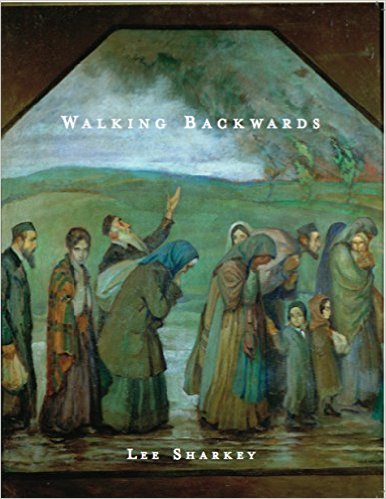
The cover art of Walking Backwards depicts post-pogrom, deported Jews. They walk forward not knowing where they go. Walking backwards, Lee sees where she comes from and backs into a past unknowable until she arrives there. Sad and broken people walk uncertainly, one foot in front of the other. Lee walks one foot behind the other until she joins them in their shared exile and wandering. The poem “In the Capital of a Small Republic,” (which is Vilnius, Lithuania) reveals how very carefully one must tread when walking backwards:
Lowering my right foot cautiously
Lowering my left foot cautiously . . .
The stones are what knowledge I have to go on
Down the seven stinking streets of this plague
The poet bravely engages in an impossible task — reversing time into the past, seeking out moments that might have been undone. Walking Backwards is about communion, reunion, dialogue, a Hasidic tale repairing the torn fabric of the universe, an attempt at restoration of human covenants, an Einsteinian walk along the space-time continuum of history. It is the rare poet who so deftly extracts the historical record into poetic forms. To reach her ancestors, Lee must walk backwards through the Holocaust, backwards to Vilnius, backwards before urban migration, backwards to pogroms and exiles, backwards to medieval wanderings to Jerusalem, backwards to crossings of the Ivrit (the Hebrews) into ancient and modern Israel. Along the continuum, Lee stops at a military checkpoint in the West Bank, where an elder Arab man and a young Israeli soldier both suffer an infernal stasis. She identifies with Palestinian women who wait and hope. Lee’s sad disappointment departs from knee-jerk Israel-bashing, being born of love and better hopes. Can our own fates be altered or undone?
Walking Backwards is a Kabbalah of poetry. Mysteries of histories are hidden between lines. An otherworldliness pervades as poems interact with ghosts and spirits, some of them European Jewish poets Lee has long travelled with — Paul Celan, Nelly Sachs, Abraham Sutzkever (survivors of Hitler’s Final Solution) and Markish Peretz (victim of Stalinist show trials and the Night of the Murdered Poets). Immersed in the poems, one grasps why Lee has sought out these colleagues, their lives radiating the poetry of loss, sorrow and the great longing for life in full bloom. Poetic dialogues may tend to the surreal, one more layer with which to grapple. Lee’s has not been an easy journey, and its telling cannot be easy or immediately comprehensible. Some digging is required for the denser pieces, and with that excavation, the reader is moved, shifted, challenged, befriended. From the poem “Ground Truthing,” we may discern Lee’s path and perhaps a message:
I was bent on knowledge
of the flowering branch the wind that sweeps the sea in its path
It has come to this
rod in hand of one who speaks with scarred mouth
storm on the mountain an arduous god
but this gift each morning
to every one his portion
that opens the matrix the fruit thereof
Lee Sharkey is a poet of love, caring for those who come to her work. The book opens with “Cautionaries,” a series of eight poems advising that what follows is not for the faint of heart, that once living people are “different from paper,” that sorrow, betrayal, shame, severed bonds and death are to be faced. Lee shows us, too, where our work as activist poets may take us. In poem #6, she says:
I slipped into the skirts of Rosa Luxemburg. . . .
Every night we commandeered a print shop;
presses clattered out the great new day.
Even now,
a century later: ink stain on my fingers.
Poem #8 cautions about lost histories, lost names and silence. With Lee, we delve into the fullness of empty places and faces. She warns that the presence of absence is overwhelming:
My friend says she will blow a hole in the silence.
I tell her to look in the mirror
to get the feel of absence.
For the poet and for us, absence is not all that’s found. The earth of our lives must at times be still and empty in its renewal to fruitfulness. Lee Sharkey is planting for the children, all of our children. And I will keep reading because this is as much a manual for living as it is a testament to those whose deaths were too often unnatural. In the final poem, “Something We Might Give,” in conversation with the Vilna poet Sutzkever and with a note from Celan, we are assured that total erasure is impossible, that “A wildflower returns to bloom in the ghetto,” that “Something nests in the chimney,” that “We empty and fill,” that we “borrow books from the unliving.” We are assured that “there remained amid the losses this one thing: language.” Lee’s last lines of the final poem invite us to begin, always to begin:
Among the slaughtered sounds a newborn silence
Genesis words to light the long slumber
— Anna Wrobel
Mortal Trash
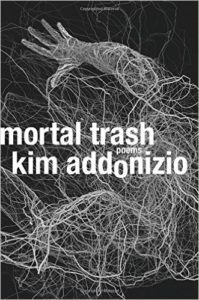 Mortal Trash,
by Kim Addonizio,
W. W. Norton & Company, 2016,
107 pages, hardcover, $25.95,
ISBN: 978-0-393-24916
Kim Addonizio is a master at roving narrative poems that take radical shifts in tone, context, and syntax, and that never fail to pack a punch. Her latest book, Mortal Trash, offers a torrent of images and experiences from someone well aware that time is limited and life is fucked up. Bursting with original language and idiosyncrasy, the book reads like the diary of a riot grrrl grown wise, still teeming with angst but also sorrow and humility.
The best poems are the ones that promise insight or advice but derail themselves off topic, like “Internet Dating.” It begins with the typical complaints, yet with clever, not-so-typical delivery:
I am tired of kissing nematodes,
splitting the check with scorpions,
listening to the spiritual autobiographies of slugs
over an infinitely repeated series
of banal gestural codes.
Mixing quotidian and fairytale with scientific language — like nematodes (tiny, invisible worms) and gestural codes (subliminal images) — creates a disorienting effect. Anyone who’s been on a dating site will tell you how lonely and clichéd it is, but by using this kind of technical writing Addonizio extracts just how impersonal it can be. Then, however, the poem takes a personal turn, as the speaker continues:
Get out of my inbox.
I feel violated. Not in a good way.
There’s no one I want to inhale into my alveoli
like I did with you. There, I just made you
into a cigarette.
We are quickly taken into second person, wherein the “you” that first appears as an offending online suitor quickly morphs into a lost love. Then the speaker’s address to the former lover takes over, asserting: “I want another you, and then another.” We are pulled into neurosis that fuels the speaker’s internet search. She continues: “If I read your profile online, I’d never write you. But I miss all the sides of your face.” As at the start of the poem, the poet seems to be commenting on how arbitrary it is that we allow algorithms to determine something as imperfect and subjective as whom to fall in love with.
The most eviscerating poems in this collection — “Seasonal Affective Disorder,” “Manners,” “Introduction to Poetry,” “Party,” “Divine,” “Candy Heart Valentine,” and “Florida” — are so sharp and dynamic — what with the “inner space heater / and TV and washing machine . . . all going at once” — it would not do them justice to share only a few lines. Other poems, however, offer an unexpected, softer lyric, like “Invisible Signals,” in which the speaker reflects upon the connection between her life and her friends’ as she sits by the East River in Manhattan:
. . . I like to think of my friends
imagining me so we’re all together in one big mental cloud
passing between the river and outer space. Here we are
not dissolving but dropping our shadows like darkening
our handkerchiefs on the water.
I love the straightforward image of a group of friends encased in a cloud floating over a river, and the picture of their shadows casting like handkerchiefs onto the surface of the water is just breathtaking. The poem continues by referencing each friend in her particular struggle in life:
One crying by a lake,
one rehabbing her knee for further surgery. One
pulling a beer from the fridge, holding it, deciding.
One calling the funeral home, then taking up
the guitar, the first tentative chord floating out,
hanging suspended in the air.
The image of each woman shows a transition point in life — another reminder of mortality, a theme that runs throughout the book. These moments of reprieve from Addonizio’s more acrobatic poems strike a balance for the reader. For example, a section of fourteen sonnets mid-way through, while still tenacious in attitude, is condensed enough to leave space for contemplation.
Behind the layers of Addonizio’s poems are three central qualities: toughness, vulnerability, and sadness. From refrains of “I feel” to text-speak to Shakespearian iambs, Addonizio finds the sacred in the profane, and like the Buddha, sees suffering everywhere. If her poems leave you tongue-tied, as they do this reader, “Manners” demonstrates, albeit ironically, how to convey gratitude:
Thank you for not sharing with me
the extrusions of your vague creative impulse.
Thank you for not believing those lies
everyone spreads about me, and for opening
the door to the next terrifying moment. . . .
— Kristen Stake