

Nightlight
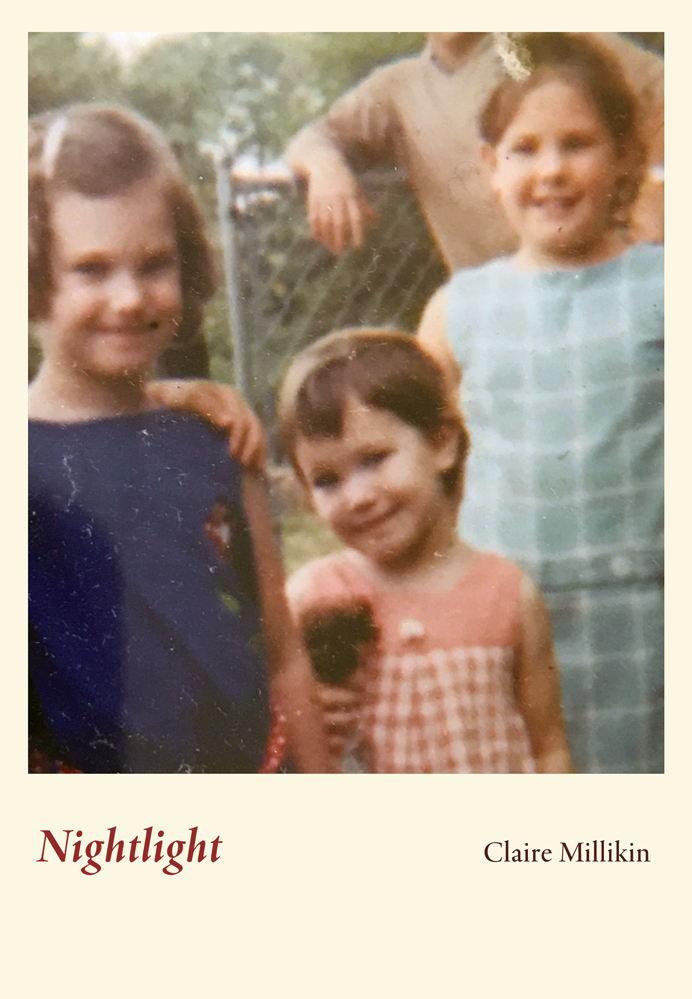
Nightlight, by Claire Millikin.
Unicorn Press, 2026,
87 pages, softcover,
ISBN 978-0-87775-238-7
Claire Millikin’s Nightlight asks us to unflinchingly confront the problematic roots of culture and place. For Millikin, that place is a struggling farm along the Ulcofauhatchee River, inhabited by a large family hovering at the edges of poverty. These family members offer love and belonging while simultaneously sheltering dangerous and abusive individuals. Millikin’s poems wrestle with Emmett Till’s accuser, the ghost of Sally Hemings, the expulsion of the Mvskoke people, Baptist churches and college quadrangles, while remaining haunted by the fading rose gardens, flooding creekbanks, murdered children, and tarnished family silver of the South’s working poor. In Nightlight, Millikin offers us a collection that unfolds like a night blooming cereus, deceptively fragile, wondrously ancient, and profoundly beautiful.
This work plays out in the image of the nightlight. As a child, the speaker mistook the flame of a confederate monument burning in the center of town for a nightlight. Even as she is haunted by nightmares in her grandmother’s “terrible house,” the speaker is already searching for an “open / place in the mind” to question the pervasive ecosystem of systemic racism.
That same tension between insidious evil and redemptive action reflects throughout the collection. From old slideshows of a vulnerable child “made of light,” to analog photos of a past whose “images emerge as elemental damage,” the poems trace an evolution from learning to recognize “what you’ve been offered as a guiding light / is worse than darkness,” to an adult speaker who asserts, I am “not ruined but intact, / clothed in multi-colored projected photographs” like a fox who “is part coyote. / Of herself she is whole.”
With poems that project out from the personal, Millikin calls us to justice for the displaced Mvskoke, black kids excluded from the local country club, countless victims of oppressive practices and every child betrayed by the very family which should have protected them. While Millikin acknowledges that this work is “not yet healed / but healing,” her poetry never loses its profound empathy for, and hope in, humanity; ancestors whose “graves are human graves.” Millikin sums up this tension in her poem, “Nuclear Reactors.” The eerie glow of the reactor, “churning light from fission,” becomes “one more place, / like I’d still go home, if it were safe;” fusing family politics and a still healing rural south into the poem’s final image of “a broken line / this well from which I draw,/this heavy water.”
Nightlight ends with reclamation of both light and the speaker’s lost childhood, as Millikin invokes a Creator who builds “your house / of indirect light” and an abused child finally proclaims “I am the dirt of stars. I am my own.” Diffused light illuminates the final poem, “Afterglow,” where a “late brightness” embraces both speaker and her adult cousin as they begin to make meaning of their past. Often poems that confront abuse and trauma can be difficult to read, but Millikin gently reminds us that, in her “family, storms are never spoken of. / We just move to the next room,” which means that this searing narrative is also performing crucial, restorative work.
Nightlight manages to be that rarest of creatures, a collection so profoundly imagined, and yet so sparingly and elegantly wrought, that we travel through it effortlessly and emerge, gently guided, into a world made deeper, more complex, and more worthy of saving. Millikin’s deft poems illuminate both danger and beauty with unflinching honesty. Even at their most shadowed, these poems transform “late / afternoon’s endured grief” to “a luminous empty place / where what was taken stays.””
—Katherine Hagopian Berry