

Beginning of the Hollow
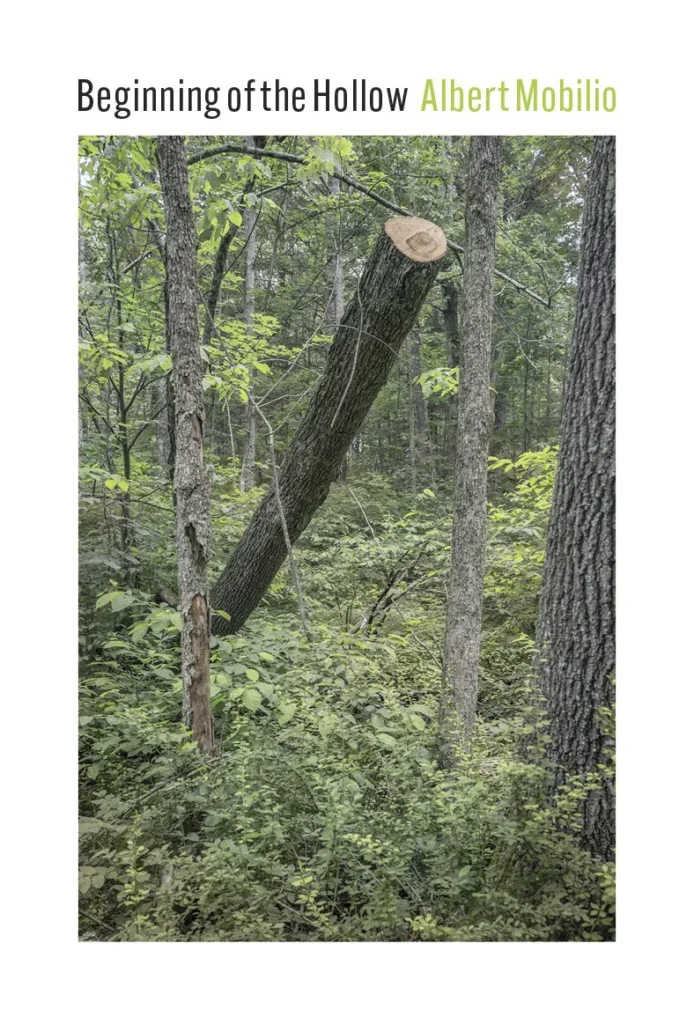
Beginning of the Hollow, by Albert Mobilio.
Black Square Editions, 2026,
144 pages, paper, $20,
ISBN: 979-8-9860370-7-3
Since his first collection of poems, Bendable Siege, came out in 1991, Albert Mobilio has been turning heads in the world of contemporary poetry through verse that startles in its fresh (in all senses of the word) language and multifarious perspectives. Mobilio can be sardonic, cheeky or teasing in one instance, hilarious in the next.
Beginning of the Hollow furthers these well-established predilections (it’s his fifth title from Black Square Editions, known for its cutting-edge selections). In four sections that move, roughly, from formalism to freeform, Mobilio continues to reflect on the zeitgeist in all its triggering manifestations.
An opening group of four poems features structured stanzas and a generally philosophical attitude, a major exception being the tartly humorous “Small Town Theodicy.” The poem “Breathing Room” is especially fine in its acknowledgment of mortal coils:
We wake one day to an understanding
about our diminishment yet
by evening, we’ve turned that corner—
the present is everything; its tedium
flaring in the window’s reflection.
Mobilio claims Gertrude Stein as a go-to writer (he fittingly won the Sun & Moon Press Gertrude Stein Award for Innovative Writing in 1994). As he explained in a 2020 interview in The Brooklyn Rail, her rhythms, playfulness and “oblique relationship to a conventional kind of sense-making” all appeal.
Mobilio’s Stein way comes to the fore in the book’s middle sections, “Beginning of the Hollow” and “Tiny White Stones.” The former, consisting of nine three-stanza pieces, each stanza nine lines long, offers self-reflection ranging from the incongruous—“Why does each profanity have a species name / attached to its basket?”—to a kind of modern-day malaise: “You’re always / asking why this doesn’t work, but did it ever?”
Mobilio embraces the surreality of existence. “I have a ticket to live on an island where everyone / owns an ocarina and the breeze does all the playing,” a narrator explains. Another tells his shrink he was born “to act with aplomb / even while enmeshed in the saving-the-farm plot.”
The nine-part “Tiny White Stones” is the most improvisational of the writing. There’s some lovely language here, even if you can’t make heads or tails of what’s happening. Take this deployment of various i sounds:
The pressure quickens, filings flake off
this hard-toiling sanity: you shift
amid a new citizenry, one whose unbottled
runes flicker just outside the screen door.
The last section, “Guide for the Discouraged (more of),” presents a plentitude of vignettes, aphorisms and fractured pensées, ranging from one-liners to existential thoughts. Sometimes they’re one and the same: “Hither, thither, then another prescription refill.”
A favorite five-liner might have served as a caption for one of Glen Baxter’s wonderfully absurd cartoons:
Sweat blurs the ole padre’s sight
as he crawls over jagged rocks
toward the fabled mount. Promised
scepter in hand, he will soon
untune the choir of cowboy laureates.
Like John Yau’s “Diary of Small Discontents,” Mobilio’s guide is full of word play. Some of it is delightfully yuck-yuck, as in “I stand corrected, only to kneel later.” Echoes of Wallace Stevens, Max Jacob and Ambrose Bierce’s Devil’s Dictionary infiltrate this entertaining smorgasbord. So many quotable lines, but let us end as the final section ends, with this invocation: “Sleep, honored dead, among the bumper cars.”
–Carl Little