

I Do Know Some Things
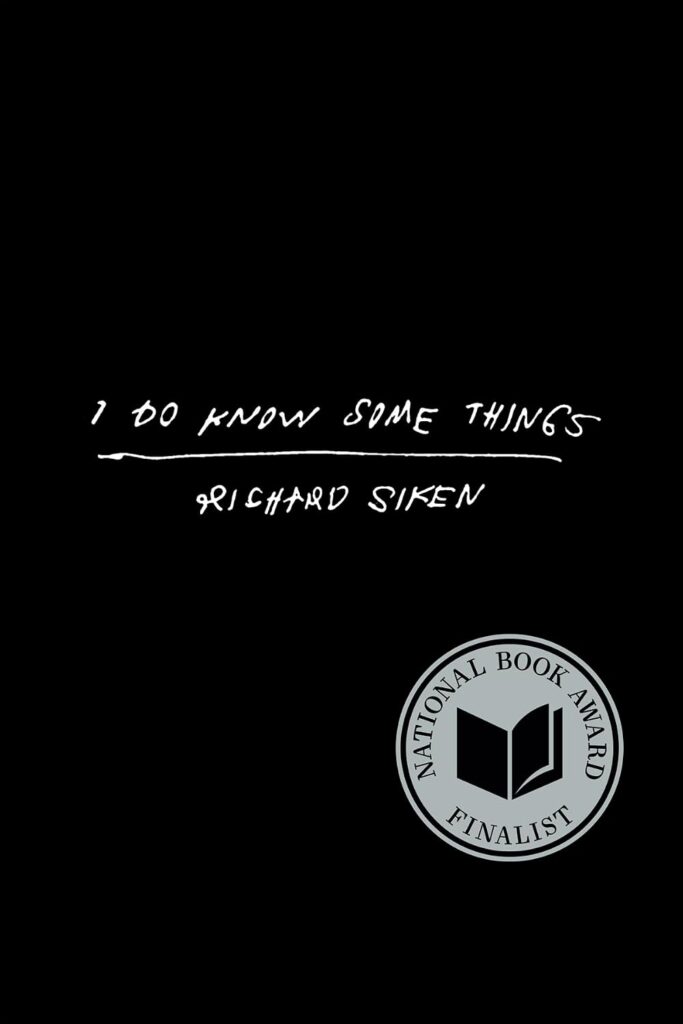
I Do Know Some Things by Richard Siken Cover.
Copper Canyon, 2025,
128 pages, hardcover, $22,
ISBN: 9781556596247
There’s something about a prose poem that wants to be surreal. Arising out of Baudelaire’s 19th century book, Little Poems in Prose, or sometimes known as The Parisian Prowler, prose poems were Baudelaire’s attempt to respond to the chaos of the city. It’s not hard to image how this led to first the Symbolists and then Surrealism. Soon after in America, there was Russell Edson, the godfather of American prose poems, whose surreal, darkly humorous, fablelike prose poems loom over everything.
This literary history is the backdrop against which Richard Siken projects the prose poems in his book I Do Know Some Things, seventy-seven prose poems, a little army of guttural realists. With their short, declarative sentences, these prose poems feel like squat machetes that hack down all attempts at any blossoming surrealisms.
And while there is real thrill in reading these poems with their surprising blunt force, they are also, mainly, understated and possess an incredibly clear-eyed moroseness. Siken calls them autobiographical poems, and they follow basically two tracks of his life: his childhood and adolescence; and the strange, languid, extended moments of time following a stroke in late middle age that temporarily took away motion and language.
Siken’s efforts to navigate the aftermath of his stroke are simultaneously thrilling and totally unsettling, bordering on terrifying. And it is this process that dictates the book’s form. In “Line” (there are a bunch of form-forward poems with titles like “Nonfiction,” “Sentence,” “The Subjunctive”), Siken writes “I wouldn’t break the line. I was afraid to. Too much was already broken. I lashed the words like pack dogs, each to each, and sledded the frozen lands for yards.” And so the prose poem becomes a necessity, a way to cope with the instability of the world, a safety zone in which risk is lessened, a box in which to pour words. I love this because it creates a new utility for prose poems, both a prosaic and a heroic function. Siken writes, “the sentence flows like water…moving forward relentlessly – sometimes in a fast run past a tight curve…or it jumps around in short, sharp bursts, choppy over the rocks, the commas, turbulent…rampageous, ungovernable.”
And so Siken creates his poetics of both necessity and aesthetics.
As with any poetics, there are things you embrace and things you push against. In the brilliant poem “Bird Trick,” Siken addresses the latter through a story about a singer-songwriter friend. “I liked his lyrics better than my poems. He left room for the music…. I fill everything up with my own stupid voice until I can barely breathe. Oh well.” And it’s true, these prose poems don’t leave room for the music, not in the sparse way of poems by someone like George Oppen or Mei-Mei Berssenbrugge. But part of Siken’s brilliance is that while this may be true (and doesn’t any poet acutely feel what he lacks?), Siken achieves his own music in these poems. It’s not a spare music, but there is undeniably music in his sentences that flow like water in their jagged bursts, their textured commas, their attempts to canopy the ungovernable.
Beyond form, this is a book of identity. And what happens when identity fails, or at least falters, and you forget the word for cheese. Or elephants. Or can opener. Or you forget how a body works. And if you then remember sometime later, are you still the same person you were before? And what happens in between, and in the meantime? And after that? “If I can’t live in my body or in my head then where does that leave me?”
As I said above, and reiterate: simultaneously thrilling and totally unsettling, bordering on terrifying! (But now I add an exclamation point because I think you, dear reader, can appreciate it). The book is not easy. But as Siken writes in “Field,” “You got some interesting clouds fucking up your sky tonight, amigo.” Oh yes, I’ve never seen clouds like this before.
—Jefferson Navicky